What Can Copilot Do? Exploring Functional Scenarios
Explore how Microsoft Copilot supports IT and Marketing teams with real-world scenarios, helping automate tasks, analyse data, create content, and accelerate project delivery.
7 May 2025
News
Discover the ethical dilemmas of AI through the Trolley Problem. Learn how industries navigate decision-making challenges with tools like Microsoft 365, Copilot, and Azure OpenAI.

The Trolley Problem is a thought experiment that has been debated for many years in relation to the ability to allow machines to make decisions whilst also running into consequences.
What decision would you take if each one delivered both success and consequence?


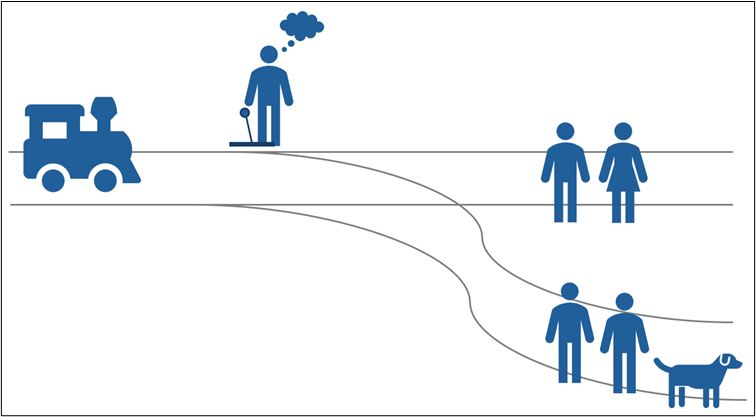
The Trolley Problem is a thought experiment that has been debated for many years in relation to the ability to allow machines to make decisions whilst also running into consequences. What decision would you take if each one delivered both success and consequence? The original scenario that started this debate was to imagine a hypothetical situation in which an individual witnesses a runaway train (or trolley) that cannot stop. This individual is at a junction with a lever that enables them to divert the trains path onto a separate track, however the issue is that on each track is a number of tied up people or animals or differing ages, gender, experience etc… If the lever is pulled then your actions would save a selected group of people/animals but put another set at risk, whereas if the lever is not pulled then the same impact will occur. In this split-second decision would you pull the lever or not? What factors would come into play to aid your decision in what path the train/trolley should take? A number of differing scenarios can be setup with this problem, to help gauge the minds of individuals in how their decision would play out. Here are some examples to consider: Track 1 has 3 middle aged men and track 2 has 3 middle aged women. Track 1 has 3 middle aged Doctors and track 2 has 3 middle aged teachers. Track 1 has a family and track 2 has 3 children. Track 1 has 3 cats and track 2 has 3 dogs.As you can see from the few examples above, the Trolley Problem starts to cause debate amongst individuals as opinion comes into play, that is impacted by peoples likes and upbringing etc… In recent advancements AI has been put into placed to deliver self-driving vehicles, and this has brought the trolley problem back into the modern ages. What if your self-driving car could not stop, and 2 different sets of people walked over a crossing, on from the left and one from the right, what lane should the car move into? Note that in this problem additional subjects need to be considered, as you have those crossing from both sides of the road but also those that are in the car at the time. There are a number of sites available that out The Trolley problem to the test, but one that is recommended is The Moral Machine; that provides a number of self-driving car scenario and measures your responses alongside others that have used the site. This offers up a really interesting experiment to see how your mind compares when involved within this debate. Is The Trolley Problem quite far-fetched? Yes. However, I believe it is a really good tool to get individuals thinking about how they would make decisions, and then relate this to the evolving artificial technologies in which decisions are left to machines. What helps us make our decisions? Our upbringing (nature vs nurture), education and experience will all play a part in this. These items can essentially be seen as the way our brains have been trained throughout our lives, so easy to map this to the need to train AI models. However, emotion and how I am feeling on the particular day when I make the decision can also impact massively, is my mind clouded by other issues? Can I not think straight? Am I angry and therefore my decisions are rash and unjust? When bringing emotion into the picture, I am now separating myself from the AI model. How does this impact artificial technology?
So how does The Trolly Problem relate to industry and the use of AI technologies?
In my opinion the key is through the decisions that are made, and how much industry will trust those decisions and act upon them. What level of due diligence will industries have in place to ensure that the decision is the correct one? This will likely differ on the industry.
A couple of examples have been provided below.
Healthcare: The strain on healthcare has been an issue for a number of years, therefore reducing this with AI diagnosis and triaging would be a beneficial improvement.
However, decisions would be needed on how much a machine can provided and how trustworthy their decisions are. If I was able to get an initial quick diagnosis by AI but then also see a doctor afterwards, with them needing lesser time to examine me as they already have some information then I would be ok with this service.
However, if AI was to complete my diagnosis, prescribe me medication or immediately book me into surgery then I would be a lot more hesitant as to the effectiveness of this. Further to this, what is AI was involved in my surgery? Would we trust AI to take the decision as to whether a wound could be sealed, or a limb needs to be lost?
Insurance: A large part of insurance is to perform checks against the individuals being insured so as to ensure payments will be received and that the level of risk is acceptable to the organisation.
The development of an AI model could speed up this service and improve it, but how can we ensure the decisions made remain ethical. Insurance checks may b based on gender, race, occupation, age, home address etc… All of these pieces of personal identifiable information (PII) can be used to mistakenly discriminate, offering up The Trolley Problem when the system selects one individual to cover over another to refuse.

Microsoft 365 provides a number of new AI tools and feature sets, with Copilot, Copilot Studios and the ability to create your own AI engines through Azure Open AI.
All of these tools will be placed in the hands of developers and standard users, who may not consider the ethical dilemmas associated with artificial intelligence. This may simply occur thorugh the data being used to train AI models being limited and introducing bias.
An example of how The Trolley Problem could be considered within a Microsoft 365 scenario is provided below. This is focussed on the need for Recruitment within industries.
Consider an organisation that wishes to build an AI recruitment engine. This could be achieved thorugh the use of SharePoint Premium (previously Microsoft Syntex) to collate CVs and tag them according to the data they contain.
This data could then be run through specific AI algorithms to immediately decide upon the CVs that should be pursued and those that should be avoided.
Following this a number of telephone and face to face interviews will take place, if these are held on Microsoft Teams the use of Intelligent Recap and Transcriptions provided by Microsoft Teams Premium and Copilot could be used to produce summaries.
These summaries could be pushed thorugh additional AI engines, to again allow it to make the decision as to who continues and who is declined.
Finally, the organisation will be left with a limited set of individuals to select from to hire. Consider how you would then make this final decision vs giving this decision to a machine. Once again, we now have a Trolley Problem, as we will be selecting who to continue with and as a consequence letting down other individuals.
The risk with AI at this stage is that the introduction of bias could lead to unethical decisions, what if every recruitment cycle ran in this way ended with AI selecting the 20 year old versus the 40 year old, what if it always selected the male candidates vs the female candidates, what if it only selected able-bodied candidates.
If this was to occur with humans making the decisions, there would be large consequences and calls against the organisation for discrimination. Again, this is where The Trolley Problem debate is critical in decisions and AI modelling.

In summary, the original Trolley Problem is a debate that forces the user to make a decision where ultimately both are bad.
This situation is unlikely to be something that occurs often, and especially not to this level in industry when working with AI.
However, the meaning behind the debate can easily be expressed across the creation of AI solutions, even those that are simply built internally across Microsoft 365, SharePoint, Copilot and Azure Open AI.
Artificial intelligence is developing and in place to support individuals and organisations. However, it is important for these individuals to continue to understand the ethical side of AI and monitor their AI to ensure it does not break their code of ethics or cause discrimination.
As a thought-provoking process The Trolley Problem can be used as a great example to help break down these potential issues and lead to great AI solutions hat fully support an organisation in the right way.
“We work with organisations across many sectors of different shapes and sizes from 10 to 100,000 employees.”
Contact our team today!

Explore how Microsoft Copilot supports IT and Marketing teams with real-world scenarios, helping automate tasks, analyse data, create content, and accelerate project delivery.
7 May 2025

Learn the key differences between Microsoft Copilot’s free and paid versions, including features, use cases, pricing, and how to boost productivity with the right setup.
7 May 2025

Discover how our consultancy team uses Microsoft Copilot across Outlook, Teams, Excel, Word and more to streamline workflows, boost productivity, and deliver high-quality client engagements.
7 May 2025