

News
Building the AI Foundation: Key Takeaways from Our Manchester Azure Roundtable
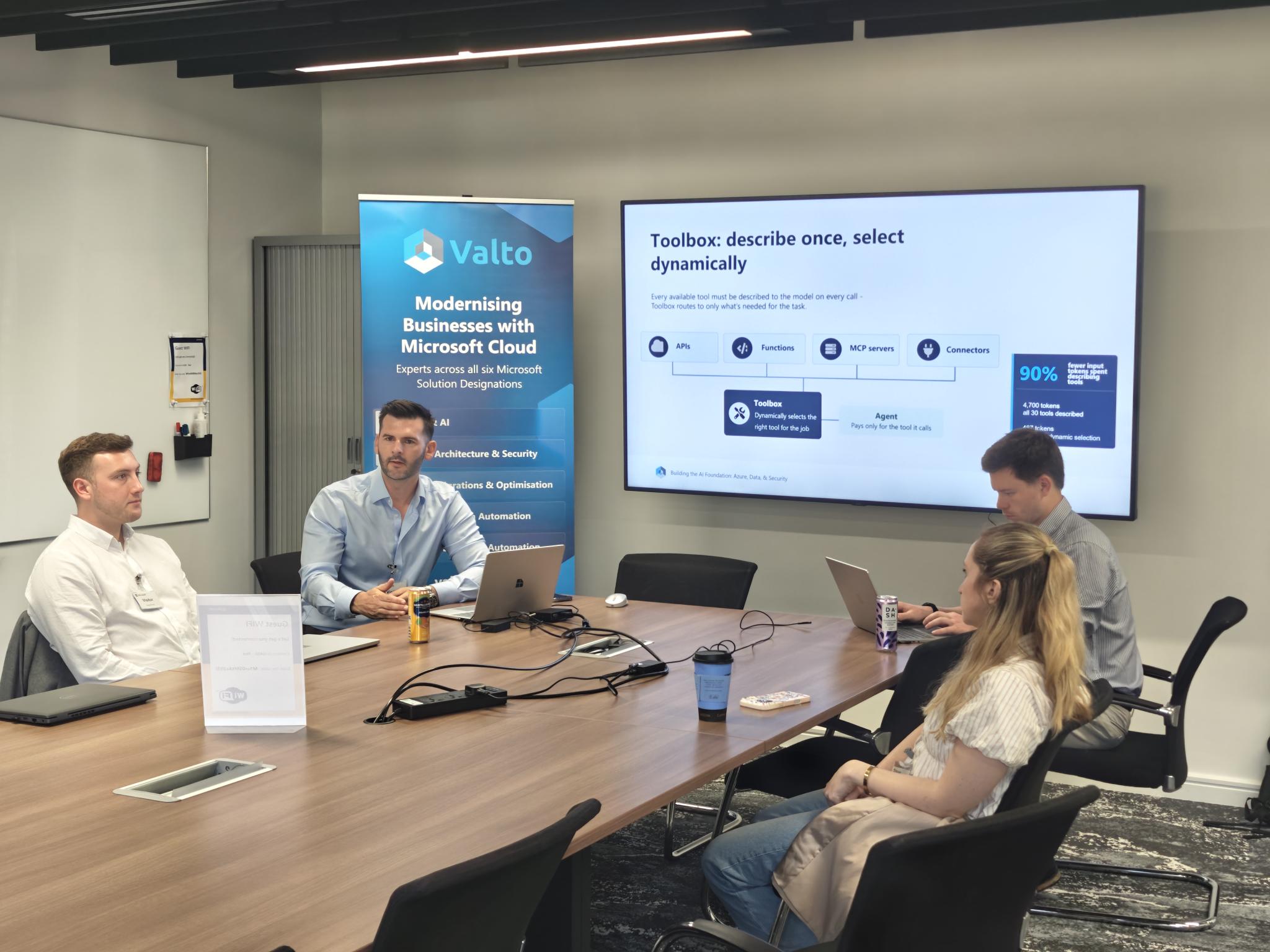
At our Manchester Azure Roundtable, experts from Microsoft, Infinigate Cloud, and Valto explored the foundations of successful AI adoption. Discussions covered Azure AI readiness, data strategy, security, governance, Microsoft Fabric, and the steps organisations can take to prepare for AI at scale.
- Published
- 4 August 2026
Building the AI Foundation: Key Takeaways from Our Manchester Azure Roundtable
Building a successful AI strategy requires more than choosing the right technology. At Valto's Manchester Azure Roundtable, industry experts explored Azure AI readiness, data foundations, security, governance, Microsoft Fabric, and AI cost management. Read the key takeaways from the event and learn how to prepare your organisation for AI at scale. Recent advancements in artificial intelligence are creating new opportunities for organisations, but they're also forcing businesses to ask an important question: Are we truly ready for AI? At our latest Azure roundtable in Manchester, we brought together experts from Microsoft, Infinigate Cloud, and Valto to discuss the foundations required for successful AI adoption. The afternoon focused on Azure governance, security, data strategy, Microsoft Fabric, and the practical realities of deploying AI at scale.
AI Adoption Starts Before the First AI Project
While many organisations are actively exploring Copilot, AI agents, and custom AI solutions, one theme emerged repeatedly throughout the event: successful AI adoption starts long before the technology itself.
Many businesses are now finding that AI exposes existing weaknesses in their cloud environments, data estates, and governance processes. Azure platforms originally designed for traditional workloads are being asked to support AI services, large-scale data access, and rapidly growing consumption models.
As a result, discussions centred around the importance of creating an Azure environment that is secure, governed, scalable, and operationally mature enough to support future AI initiatives.
Why AI Readiness and Azure Readiness Are Now the Same Conversation
Historically, Azure projects focused on cloud migration, infrastructure modernisation, security improvements, and cost optimisation. Today, organisations are increasingly prioritising AI readiness, data accessibility, governance, and intelligent automation. The challenge is that many businesses are attempting to scale AI without first addressing underlying issues such as fragmented data, inconsistent governance, unclear ownership, and legacy workloads. The session highlighted several common warning signs organisations should watch for, including: These challenges are becoming increasingly familiar as businesses move from AI experimentation to production-scale adoption.
- AI pilots that continue consuming budget after testing ends
- Poor visibility of AI-related costs
- Weak identity and access controls
- Duplicate environments and workloads
- Unclear accountability for AI governance
Data Remains the Biggest Challenge
Although conversations around AI often begin with models and tools, data quickly became one of the most discussed topics of the day.
AI systems are only as effective as the information available to them. If data is duplicated, fragmented across multiple systems, lacking ownership, or difficult to access, organisations will struggle to realise meaningful value from AI investments.
Attendees discussed the importance of establishing trusted, governed, and accessible data foundations before pursuing more advanced AI initiatives. This includes improving data quality, reducing silos, clarifying ownership, and creating a single version of the truth across the business.
For many organisations, preparing data for AI may ultimately prove more challenging than deploying the AI technology itself.
Managing AI Cost and Governance
As AI adoption accelerates, understanding and controlling consumption is becoming increasingly important.
The roundtable explored how AI services introduce new cost considerations, particularly around model selection, token consumption, retrieval strategies, context management, and application design. Rather than focusing solely on reducing spend, discussions centred on building efficient AI solutions that balance performance, governance, and financial control.
Participants also examined the role of governance in ensuring AI projects remain secure, controlled, and aligned with business objectives.
Security Remains a Critical Foundation
Security formed a significant part of the conversation, particularly as organisations look to deploy AI more widely across their environments.
Identity management, Conditional Access, Privileged Identity Management (PIM), Azure Policy, Defender for Cloud, and Zero Trust principles were all identified as essential building blocks for secure AI adoption.
As AI agents, copilots, and automated services gain greater access to business systems and data, organisations must ensure governance frameworks evolve alongside them. Effective AI adoption depends not only on what AI can do, but also on how securely it operates within an organisation’s environment.
Microsoft Fabric and the Future of Data Platforms
The latter part of the event focused on Microsoft Fabric and its potential to simplify modern data estates.
Many organisations are currently managing multiple data platforms, analytics tools, storage services, and reporting technologies simultaneously. This can create unnecessary complexity, fragmented governance, duplicated data, and unpredictable costs.
The discussion explored how Microsoft Fabric brings data integration, analytics, governance, and reporting together through a unified platform built around OneLake. By reducing data silos and simplifying architecture, organisations can create stronger foundations for both analytics and AI workloads.
Key Takeaway
The biggest takeaway from the Manchester Azure Roundtable was simple: AI success depends on far more than AI technology.
Organisations that focus on data quality, governance, security, cloud maturity, and operational ownership today will be far better positioned to scale AI successfully tomorrow. Whether the goal is Azure optimisation, AI adoption, Microsoft Fabric implementation, or broader digital transformation, strong foundations remain the key to achieving long-term value from AI investments.
Do our takeaways mirror your current business challenges? Reach out.
Whether you’re exploring Microsoft Fabric, reviewing AI readiness, or looking to optimise Azure for future AI workloads, we’d be happy to continue the conversation.
Microsoft Services Trusted by Leading Brands
“We work with organisations across many sectors of different shapes and sizes from 10 to 100,000 employees.”
Talk to our team
Stuck on Access? Contact Valto
Related reading

EventAI & Automation
What’s next? How data, automation & AI are reshaping business
17 November 2026 · 11:00 · 20 Stories, Manchester

NewsAI & Automation
Valto and Holstein UK launch major multi-year digital transformation programme
New partnership will modernise core systems and create a connected, data-driven platform powered by Microsoft technologies.
6 October 2026