Valto — Keep ahead of tomorrow

News

The AI Maturity Model: from first use cases to mission-critical AI

Explore Valto's four-stage AI Maturity Model and what UK search data reveals about the shift from AI curiosity to implementation, governance and real value.

AI & Automation
Author
Hugh Valentine | 5 minute read
Published
28 October 2026
Valto Insight graphic titled “Valto’s AI maturity model”, featuring a circular photograph of a person seated in a chair alongside Valto branding.

At Valto, we are seeing more and more organisations embrace AI, and they are all at different levels. Some are under pressure from the board to use AI but have not yet found clear use cases. Others have people building their own agents and prompts that are already showing a return. And many have rolled something out, only to find it is not quite delivering the value they need.

To make sense of that journey, our CEO Hugh Valentine has broken it down into four stages: the AI Maturity Model. In this article, we explain each stage, what it looks like in practice and how we help organisations move on to the next one.

What is Valto’s AI Maturity Model?

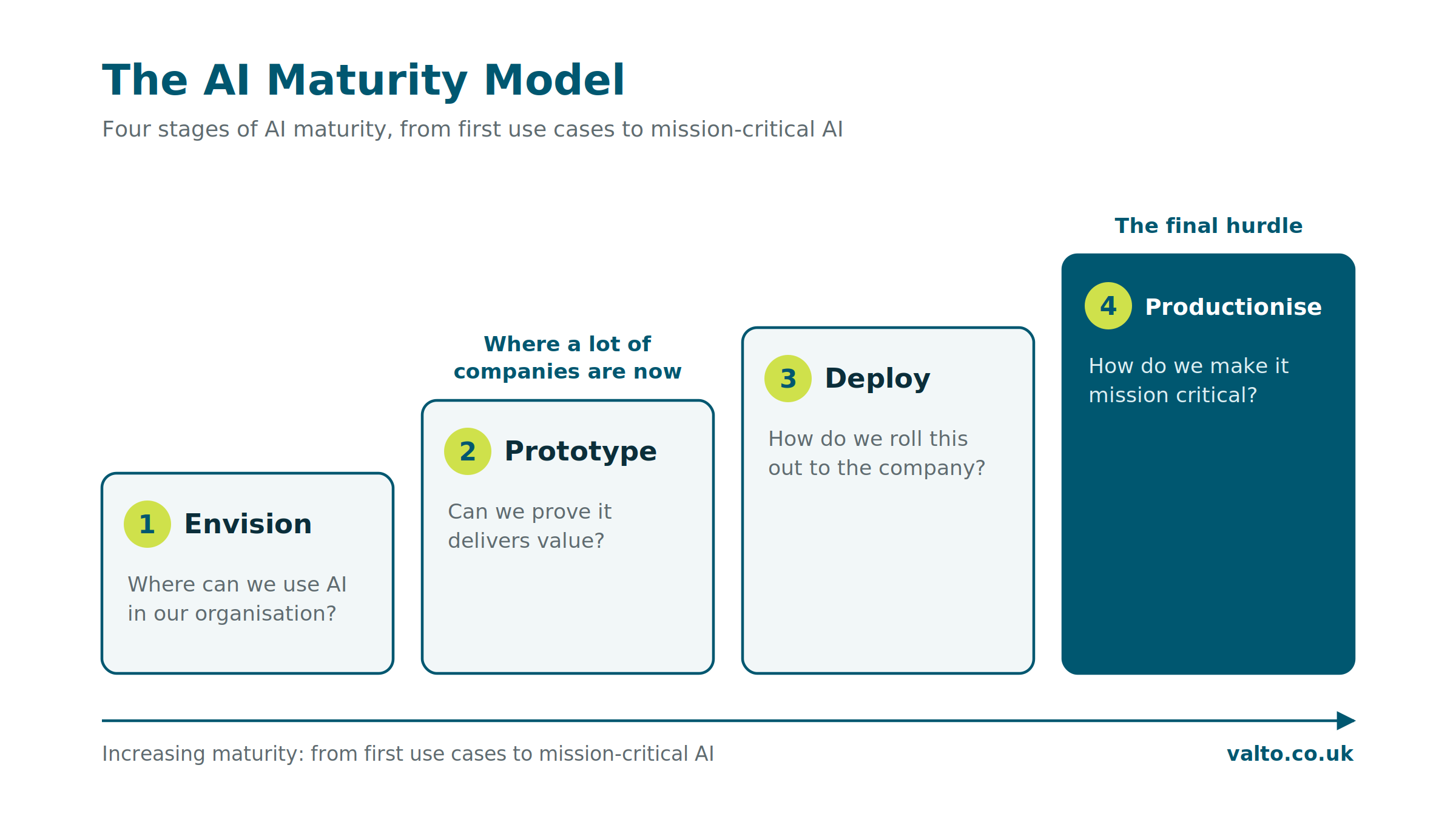
The AI Maturity Model describes the journey organisations take from identifying their first AI use cases to running mission-critical AI solutions. Each stage is defined by the question the organisation is trying to answer.

Diagram showing the AI Maturity Model progressing through four stages: Envision, identifying where AI can be used; Prototype, proving value; Deploy, rolling AI out across the organisation; and Productionise, making AI mission-critical. The graphic highlights Prototype as where many companies are now and Productionise as the final hurdle.
The four stages of AI maturity, from identifying initial use cases to making AI mission-critical.

Stage 1: Envision

The question: Where can we use AI in our organisation?

At this stage, organisations are trying to understand where AI fits. What are the use cases where we could start using tools like Copilot, ChatGPT or Claude? Often there is pressure from the board to start identifying them, but no clear use cases yet.

How we help: our envisioning session. We sit down with your teams to understand your ways of working and how each department uses its tools. We then come back with a report recommending how to deploy and roll out AI, with use cases ranked on return on investment and ease of implementation. That way you can go after the quick wins with a big return, while planning in the larger, more strategic opportunities.

“We’ll be honest as well, not all of the answers are always AI. We do come across solutions using SharePoint and automation and Power Platform. These AI conversations are triggering people to look at their ways of working and processes.” Hugh Valentine, CEO, Valto

Organisations are clearly looking for this kind of help. UK searches for “AI readiness assessment” more than doubled in the past year.

Stage 2: Prototype

The question: Can we prove it delivers value?

Here, people across the organisation have started using tools like Claude and ChatGPT, and some have built things that are already delivering a return: their own small agents or prompts that save real time. They are now showing the business what they have built and making the case for investment to roll it out.

“They’re showing the organisation: I’ve got a great use case here, and I know that if I can get some investment, I can start to roll that out. That’s probably where a lot of companies are now.” Hugh Valentine, CEO, Valto

The appetite to build is clear: UK searches for Copilot Studio, Microsoft’s tool for building agents, rose 62% in the past year.

Stage 3: Deploy

The question: How do we roll this out to the company?

Organisations at this stage have secured funding and investment on the back of a successful prototype. They are now looking at the next step: getting that solution in front of a much wider user base.

How we help: our new app scoping. We work with you to understand how your prototype works and what your ambitions are for rolling it out. We then put together a programme of works to take that AI solution across the rest of the organisation.

The market is moving the same way, from experimenting with agents to putting them to work. UK searches for “AI agents for business” rose 88% in the past year.

Stage 4: Productionise

The question: How do we make it mission critical?

This is the final hurdle. The organisation has rolled out an AI solution, but it is, as Hugh puts it, “held together with sellotape or zip ties”. It is saving some time, but it is not fully integrated into the workforce. People still have to push it forward, maintain it, or fix it when it breaks. The organisation knows it could be a really valuable tool, but it is not yet delivering the value it should.

We spend a lot of time with organisations at this point. What holds them back is rarely the AI itself. More often, it is a prototype built for speed rather than scale, without the governance, security or cost control a business-wide solution needs.

“They know now without a doubt that this could be a really valuable tool, but they’re just struggling with that final hurdle of how we now get it rolled out properly across the organisation.” Hugh Valentine, CEO, Valto

How we help: moving it to Azure AI Foundry. We can move your AI solution into Azure AI Foundry using exactly the same models, whether it was built on Claude or ChatGPT. That immediately brings governance, cost control and security, and lets us build proper processes around it. The result is no longer held together with sellotape: it becomes a valuable, mission-critical application that achieves what it was meant to, whether that is replacing or automating a function.

“What that will immediately give us is governance, cost control and security, and I can start to build some processes around that. It’s not held together with sellotape or zip ties, and it’s now become a mission-critical, valuable application.” Hugh Valentine, CEO, Valto

Governance is becoming a priority across the market too. UK searches for ISO 42001, the international standard for AI management systems, rose 42% in the past year.

Where are you on the model?

The key is to be honest about where you are today, then take the next step: start with use cases ranked on return and ease of implementation, prove the value with prototypes, deploy as a planned programme of works, and productionise with the governance, cost control and security a mission-critical solution needs.

Does this resonate? Contact us today

Wherever you sit on the AI Maturity Model, talk to our AI consulting team about an envisioning session, new app scoping, or getting your AI solution production ready.

Search figures are from Semrush UK data, October 2026.

Share this

Related reading