Speakers:
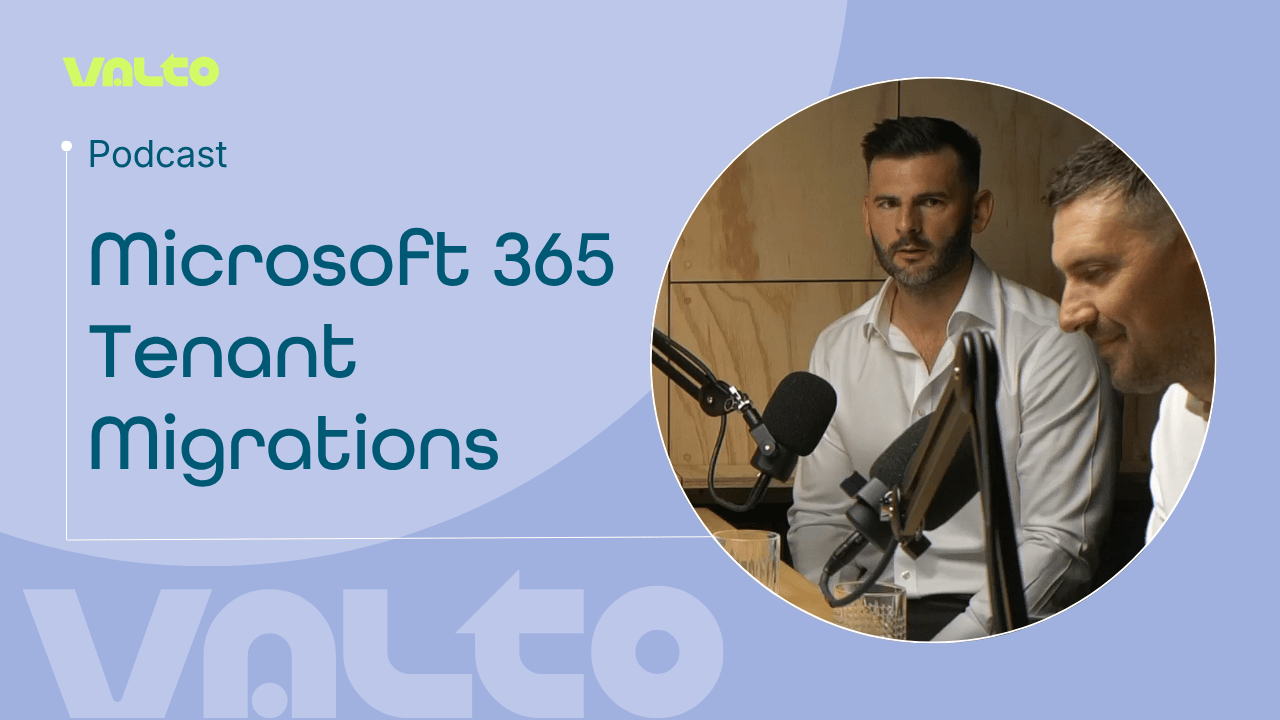
Harry Barnett – Pre-Sales, Microsoft 365 & Modern Work, Valto
Rob Thomas – Head of Modern Workplace, Valto
Will – Senior Consultant, Valto
[00:00:00] Harry Barnett:
Hi, I’m Harry. I’m part of the pre-sales team here at Valto for Microsoft 365 and Modern Work. I’m in discussions with customers from discovery all the way through to project finish, really, to make sure everything’s running smoothly and, commercially, everything’s all there.
[00:00:17] Rob Thomas:
Hi, I’m Rob Thomas. I’m Head of Modern Workplace here at Valto. I basically lead the business unit within the organisation, aligning sales, delivery and operations, and ensuring high-quality customer outcomes and repeatable success.
I’m almost like a mini managing director for that business unit, and I set the strategic direction of that business unit.
[00:00:40] Will:
Hi, my name is Will. I’m a Senior Consultant at Valto. I work with the Microsoft 365 team with Rob. I’m mainly involved with pre-sales and technical workshops, and I’m often the technical lead on those projects as well.
What we’re seeing right now is quite a big increase in mergers and acquisitions, and with that, tenant migrations are spiking.
This means that people are joining completely different IT environments together and, a lot of the time, we’re seeing multi-tenant strategies.
Is there anything that you’re seeing specifically, Rob, from your position as head of the business unit?
[00:01:18] Rob Thomas:
Yeah. I think the biggest opportunities we’re seeing coming out of the current mergers and acquisitions activity are opportunities for these businesses to engage in transformation.
They can standardise their operations and improve efficiency across existing applications. Probably one of the main areas is strengthening security and governance, getting all of that set up correctly for the new phase.
Especially with the deliberate growth strategies that these businesses have, security and governance are really important.
The end goal is also to improve client experiences, and probably the internal experience as well, through better collaboration.
It’s quite an interesting shift in technology, particularly around Microsoft 365. It’s no longer just about supporting what they’ve got. It’s about enabling better use of all of those tools across the stack.
It’s a really interesting shift. It’s not just about acquiring more revenue for these companies. It’s about enabling and empowering their people and their customers.
[00:02:29] Harry Barnett:
When we’re speaking to businesses about that immediate need for a tenant migration, whether it’s part of a merger and acquisition or simply a tenant migration, it always comes with challenges.
The first thing we often see is around education. We always spend that initial pre-sales discovery educating rather than immediately looking at an approach or delivery.
Will, are there any specific challenges that you see, from a customer’s point of view, that immediately come up in a tenant migration?
[00:03:02] Will:
Yeah. The biggest thing we see, depending on the size of the migration, is whether the client wants long-term coexistence.
If, for example, there are hundreds of users, there are challenges with going live all at once. That’s probably one of the biggest things we see.
It’s a case of planning, using our tools, putting together the architecture and making sure everything can coexist in between. We can then carry out these tenant migrations without having to go live all in one weekend. We can phase it and batch it.
With Microsoft 365, we can only have the domain in one tenant at a time, so we have to use various tools and technologies to allow migrated users to continue sending from that domain.
[00:03:57] Rob Thomas:
One of the biggest things when we’ve got these large acquisitions is that leadership quite often wants all of the sub-entities to follow one domain and one brand identity.
The biggest thing for them is moving everyone into a consolidated tenant so they can operate from the same domain. We’ve had quite a few of those engagements.
One of the last ones we did was with one of the companies that does translation for Netflix shows. They had organisations literally all around the world and needed to move into the central brand.
That was the biggest thing driving that engagement. Leadership had tight deadlines for when they could start using their new domain, and that tied into their marketing.
Alongside what leadership wanted came security, compliance, all the different systems that needed integrating and all the additional things we had to take into consideration to enable collaboration between those different entities.
There was a lot of discovery work that went into those things, even for something that initially appeared quite simple.
[00:05:07] Will:
Yeah, and there are lots of things to think about when you’re doing a tenant migration. It’s not just email. It’s not just OneDrive. It’s not just SharePoint.
There’s a completely different perception when you actually get into the tenant and start looking at it.
You’ve got Power Apps, the Power Platform, phone systems, different types of app integrations, third-party enterprise apps and all that type of stuff.
When customers first think about tenant mergers, they can overlook those pieces. That’s where we come in and say, “Have you thought about this? Have you thought about that?”
They can often find lots of things in there.
[00:05:53] Harry Barnett:
Amazing.
That brings us to our approach as well. We always start by getting a clear view of what’s there: users, identity, security, data, the lot.
From there, we can stand up the new environment properly, make sure we know what good looks like, educate the customer on what that looks like as well, and run the migration as smoothly as possible rather than jumping straight into it, which is where some of the nightmare stories that we often hear come from.
When you talk about consolidation, Rob, when does it make sense for customers to consolidate, and what benefits do they get from that?
[00:06:34] Rob Thomas:
I think it depends on the organisation and, quite often, how they’re set up.
I would say consolidation makes sense if you’ve got organisations acquiring completely different entities and they want to move to a single collaboration point, adopting things like the same domain, like the Netflix organisation needed.
Especially if you’ve got organisations with all sorts of different IT systems that need more integration, the consolidation model is probably best.
We’re at the point now where a lot of organisations are basically multi-tenant anyway. The Microsoft 365 tenant is almost like what the server was back when we were doing these mergers and acquisition projects.
A lot of enterprises have multiple tenants, with development tenants and test tenants. They’ll have tenants they use internally and then tenants containing applications that might be more customer-facing. So, they’re already set up in that scenario anyway.
[00:07:36] Will:
Franchises.
[00:07:37] Rob Thomas:
Yeah, exactly. The franchise model is probably one of the areas where multi-tenant, almost like a hub-and-spoke model, really benefits them.
They can have a central tenant containing all their internal staff and host all their internal applications and CRM.
Then we work with them to set up what we call an MTO, a multi-tenant organisation setup. We basically connect all of these different franchise firms to the central tenant.
They can then share things like identity and collaborate using Teams and SharePoint, essentially their communication stack. They can also access custom CRM platforms, Dynamics and any SSO apps.
[00:08:24] Will:
You have a universal address list in there as well, so they can search for all the contacts.
[00:08:29] Rob Thomas:
Yeah. Some of the tools that are out now include third-party tools, such as Enforcer, which we use to create security blueprints.
We can define a best-practice security blueprint and automatically apply that to all our customers’ tenants, or the tenants that an organisation owns, so they’re all aligned to the same blueprint.
It’s very scalable and very repeatable.
Microsoft themselves are bringing out a multi-tenant management capability built into the Entra Suite. It’ll operate a little bit like Enforcer, but it’s going to be first-party.
It’s going to allow enterprises to manage hundreds of different types of resources across tenants, create baselines, and report on discrepancies in configuration or configuration drift.
There’s a lot going into managing organisations that might not be consolidating but are adopting that multi-tenant model.
There’s no right or wrong answer. It comes down to things such as the size of the IT team managing the organisation and their collaboration model.
Franchises tend to have different domains, whereas organisations pursuing a strong acquisition strategy may be trying to bring people under the same brand.
That determines what the best outcome is.
[00:09:55] Harry Barnett:
We talk a lot about security baselines and proactive security. Can you walk us through a proactive approach to security and what that looks like when customers are integrating new businesses?
[00:10:10] Will:
Yeah. The security side is normally the first piece we look at when we’re considering a tenant migration.
We wouldn’t want to migrate one tenant into an unhealthy tenant. That’s often the first piece within pre-sales, where we’ll carry out a full assessment of the tenant.
We’ll look at existing policies, Conditional Access and anything that might cause an issue after the migration.
It’s always good to be migrating into a healthy, secure tenant rather than migrating another company in when the tenant is already not in good shape and then having to fix all the issues post-migration.
[00:10:50] Rob Thomas:
Yeah. It’s already a slightly disruptive exercise when organisations are moving to different tenants. It’s very user-impacting in terms of what people have to do.
Things such as setting up identity and MFA are going to have to be done at some point anyway.
Every acquisition is going to introduce a new risk profile, so having those security insights is really important from the beginning.
Identity is the new perimeter, so that’s often the first thing we look at. We try to spot risky behaviour and analyse sharing and data exposure.
That’s especially important if an organisation is buying or acquiring another company where they’ve got much stricter data risks and different requirements they need to adhere to.
[00:11:42] Will:
Retention, DLP.
[00:11:46] Rob Thomas:
Yeah. The aim is never to inherit something blindly.
We do a thorough investigation of the environment, even if somebody else or another partner has started that journey with the customer and we come on board later.
We’ll still do that thorough deep-dive analysis ourselves so that we can understand absolutely everything.
Trying to get towards that Zero Trust framework is probably where we work to, but every organisation is different.
[00:12:16] Harry Barnett:
Amazing.
When we talk about success in a well-executed acquisition, merger or migration strategy, it always starts with that discovery piece.
A lot of the time, the customers we’re speaking to are under time pressure. It’s about getting the right information in front of them and educating early, but also giving them a really solid approach, or often multiple approaches, that they can choose from.
Is there anything else you’d say contributes to a well-executed strategy for a full migration that we help with?
[00:12:49] Rob Thomas:
I think it’s understanding the customer, how they operate and their needs.
There are multiple options. You’ve got the single-phase migration, or “big bang” migration, as you like to call it.
[00:13:00] Harry Barnett:
Yeah.
[00:13:00] Rob Thomas:
It really depends on the number of workloads we’re moving over, the geographical location of the customer and the time zones.
For larger enterprise engagements, we would usually set up a proof-of-concept migration as well so the technology team, and maybe even the board, can see what the experience is like.
We would probably then move to a multi-phased migration, moving workloads and users over in waves or batches and taking a more controlled approach.
We’d also have a continuous feedback loop to support continuous improvement. If there are any issues and we need to tweak the methodology, those lessons go back into the next batches and waves, continuously improving the experience.
It all starts with the initial assessment with the customer and the consultative approach, applying our 15 years of knowledge that we’ve built up over time.
We look at the scenario, determine what needs to be done and identify a target state for where we want to get to. From there, we move into planning and execution.
[00:14:24] Will:
Yeah, planning is obviously a big part of it as well. The plans really have to be watertight.
[00:14:33] Rob Thomas:
Yeah. I’d say the biggest thing is setting the customer’s expectations.
There are always going to be some disruptive elements to a tenant migration. You’re moving a lot of data and a lot of identities.
[00:14:46] Will:
And devices, potentially.
[00:14:47] Rob Thomas:
Devices, applications. There’s always a transition state in the middle where you move to that next phase.
It’s about setting the customer’s expectations, from the end user right up to board level.
Everyone knows the dependencies, risks, assumptions and the experience they’re going to have. That’s something that’s really important.
We’re always upfront right from the start, so customers know what’s going to happen and what it’s going to be like. I think that’s probably one of the biggest things.
[00:15:21] Harry Barnett:
If you’re going through a merger or acquisition, or managing a multi-tenant environment, that’s exactly where Valto can come in and help.
We guide you from strategy through to delivery and ongoing support for migrations and mergers.
You can reach me at [email protected]. I’ll put the details below.