
Azure Migrations
Migrate to Azure, or move your Azure to Valto
Whether you're moving servers from on-premises, workloads from another cloud, or your Azure billing from another partner or credit card, Valto will plan and manage the move while adding value on top. Book a free discovery call and we'll send you a proposal for budget purposes, setting out the cost, approach and timeline.
Rated 5 stars in Google
Plan your Azure migration

Trusted by organisations like yours






Sound familiar?
Where most Azure Migration projects start
Pick the situation closest to yours. Rest assured that if it's listed, we've done it before.
- Servers and applications still run on-premisesServers and applications still run on-premises: Book a discovery call
- You're moving from AWS or Google Cloud to AzureYou're moving from AWS or Google Cloud to Azure: Book a discovery call
- You buy Azure through another partner and want more valueYou buy Azure through another partner and want more value: Book a discovery call
- You pay for Azure on a credit card and want monthly invoicingYou pay for Azure on a credit card and want monthly invoicing: Book a discovery call
- You want a review of your existing Azure estateYou want a review of your existing Azure estate: Book a discovery call
- You're moving a data warehouseYou're moving a data warehouse: Data Strategy & Migration
How it works
How your Azure migration works
Every migration starts with a free discovery call, so you know the approach and cost before anything is paid for.
- 01Free
Free discovery call
We look at what you run, where and how you buy Azure today.
- 02Fixed price
Migration Assessment
Workloads, costs and risks assessed, with a plan and fixed price.
- 03Secure foundation
Landing zone
A governed Azure foundation set up before workloads arrive.
- 04Low disruption
Migrate in waves
Workloads moved and tested in planned waves.
- 05Right sized
Optimise
Workloads right sized and costs reviewed after the move.
- 06Keeping you ahead
Free annual reviews
Annual review of costs, security and governance when you buy Azure through us.
“Whether dealing with Microsoft 365, Azure, Virtual Machines or security, their technical capability is exceptional. There is always access to specialists who genuinely understand the technology and can provide clear, pragmatic advice.”
Case study · Vertical Systems
Vertical Systems Azure Migration to Retire On-Prem Infrastructure
Vertical Systems partnered with Valto to migrate approximately 70 servers to Microsoft Azure, retiring legacy physical hosting environments to reduce costs, improve performance and increase system stability.
- ~70 servers migrated to Microsoft Azure
- Reduced costs
- Improved performance & stability
Microsoft expertise you can trust
Valto are one of the UK's few Microsoft Partners to hold all Microsoft Solution Partner Designation Badges, across all Microsoft Solution Partner Designation Pathways. For our customers, this means you can rely on one partner for end-to-end support across all your organisation's needs.
All Microsoft Solution Partner Designation Badges
Our Azure migration services
Valto can support every kind of move to Azure
01
From other partners (EA or CSP)
Azure subscriptions moved to Valto, with free annual reviews on top.
02
From credit card to monthly invoicing
Predicatable monthly invoices instead of card payments.
03
On-premises to Azure
Servers and applications assessed, planned and moved with minimal disruption.
04
Other clouds to Azure
Workloads moved from AWS, Google Cloud and other providers.
05
Beyond traditional laaS
Complex workloads modernised onto PaaS, containers, integration and serverless services.
06
Data platforms
Data warehouses and analytics moved to Azure and Microsoft Fabric.
Not sure where you fit?
Book a free discovery call and we'll point you to the right starting point.
Get to know Azure & Azure Migrations
Real examples of why a move to Azure can benefit your organisation.
Watch · Podcast
Cost Optimisation & Security in Azure
Learn why many organisations still treat Azure as a simple "lift and shift" of on-premises infrastructure, the risks this creates, and how a structured approach to governance and optimisation can unlock significant savings and improve resilience.
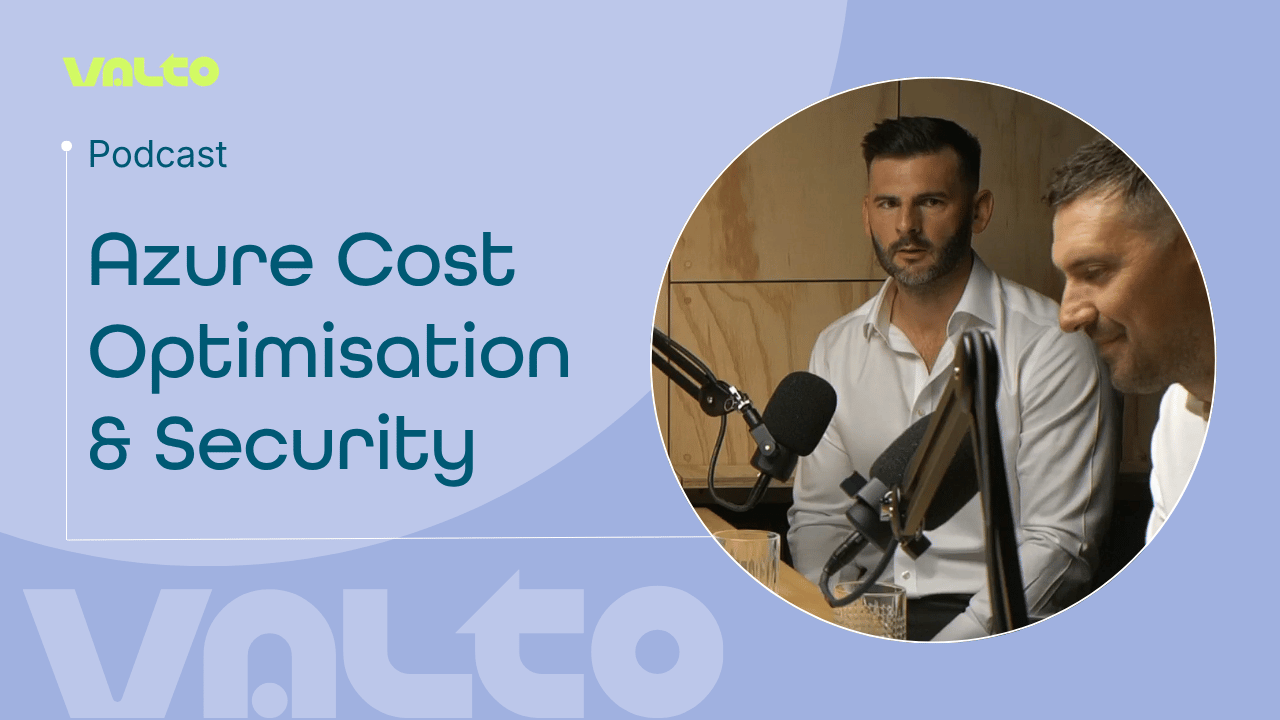
Transcript: Cost Optimisation & Security in Azure
Transcript: Valto Azure Events, Governance and Cost Optimisation
Speakers:
Harry: Valto interviewer and event host
Rob: Valto Azure specialist
[00:00] Harry:
Valto host an abundance of events throughout the year. We try to do two every quarter. We host one in London and one in Manchester. They're usually co-hosted with Microsoft at the Microsoft offices.
We've held events this year around building intelligent intranets, specifically using AI and Copilot, as well as exploring modern work and how HR and communications teams can improve collaboration and communication across their organisations.
We've also hosted some smaller roundtables, where insights can be shared and companies and organisations can learn from one another, as well as listen to us.
Most recently, we were in London and Manchester hosting events on Azure security and cost optimisation, alongside sessions covering Azure AI Foundry and Microsoft Fabric.
Rob's here to talk a little bit about how those events went, what he spoke about and the kinds of people who attended, as well as the insights they gathered.
[01:04] Rob:
I think both events were really good. Both were well received and we got good feedback. There were a lot of good insights as well, especially around cost optimisation.
That's one of the really big things that causes friction between finance teams and technical teams trying to achieve business goals.
We often see development teams building applications for the organisation, but then the costs completely run away with them. Organisations can struggle to rein those costs back in while still enabling those services for their customers and their people.
So, that was a really interesting insight.
The other area was more around the shared responsibility model. Microsoft manages the data centre and the Azure platform itself, but customers still need to apply security and governance to their Azure estates.
We covered quite a lot of examples of customers moving legacy infrastructure from co-location rack space and on-premises environments into the cloud.
While that gets them away from physical equipment, they may not necessarily have adhered to the Cloud Adoption Framework.
There are plenty of enhancements that can be made, including cost optimisation and security improvements.
One area people were particularly interested in was governance and landing zones. This is about creating a secure, governed blueprint for your cloud environments that is repeatable and can be redeployed.
Microsoft had also recently released landing zones for AI and Azure AI Foundry, so we covered some of those new offerings and technologies that Microsoft has produced to help customers get the best out of their Azure platform when hosting AI solutions.
There were plenty of insights and good conversations coming out of both sessions, so it was really good.
[03:22] Harry:
And with customers that have worked with us on Azure specifically, you mentioned landing zones and governance. Are there any specific challenges they come to us with that we need to immediately either educate them on or adapt to?
[03:38] Rob:
I think the challenges are quite broad.
The biggest thing we see is that whatever customers have built in Azure has quite often just been a lift and shift.
Whether it was previously located on-premises or in rack space, they've just moved it over into the cloud. It's essentially a carbon copy of what they had on-premises: legacy infrastructure and systems with a lot of IT technical debt.
They haven't leveraged the more modern platform-as-a-service technologies or utilised the different availability zones in Azure.
They also haven't necessarily taken advantage of the benefits of Microsoft Defender for Cloud, enabling Defender for Servers plans and the security products available across their different resources.
I think the biggest challenge is that Azure has just become a carbon copy of what their on-premises environment was, but in the cloud.
There is still plenty of innovation, optimisation and cost savings to be made.
That's probably the biggest thing we discussed and identified.
[04:45] Harry:
One of the main things that actually came out of the event, from a lot of the industries involved, especially financial services and retail, and sometimes hospitality and tourism, was that focus around cost optimisation and governance.
But how, when and where do they start?
Could you give us a bit of an indication of what we do to help with that and where to typically start?
[05:06] Rob:
Where we typically start with customers who are assessing their environment and looking at things like optimisation is with our assessment platform. We call it Azure Scout.
It's one of the largest FinOps tools in the UK. I think around 40% of Azure consumption actually goes through this tool.
What we can do is carry out health checks. Customers can sign up for free, and we can onboard them onto our platform, where we assess their Azure resources.
We don't need to view any of their data or anything like that. It's quite a passive assessment.
Within five to seven days, we can assess their entire Azure estate and produce a comprehensive report.
This looks at things like cost optimisation opportunities that customers might not currently be using. For example, reserved instances.
We can also look at things like a lack of tagging within the Azure environment. That often leads to a lack of governance when there are no tags in place for tracking spend and understanding cost centres.
We can identify zombie resources: things that have been deployed but are never actually used, just continuing to generate costs.
We also look at Log Analytics and storage usage.
We've got things like Azure Secure Score, which provides a numerical representation of the environment's security posture. We'll report on that as well, giving customers an idea of where they are on that journey.
Microsoft recommends a minimum score of 65%. We do try to get customers above that, depending on their resources as well.
We also look at the use of other technologies, such as Fabric, microservices architecture and Kubernetes, which development teams might be hosting.
Once we produce that report, we can sit down with a consultant and explain the opportunities.
For example, customers can move their subscription to the CSP model, where they host their Azure subscription through Valto.
There's no fundamental change. You still own the subscription; it's simply the billing model that changes.
Once you move it over, we can start working with you on cost optimisation and enabling additional features.
We also have access to around 300 custom dashboards, which are powered by AI.
They don't use Azure Advisor, which is what most end customers tend to rely on. Instead, there's an external AI engine that identifies the best optimisation opportunities.
It can identify things like overprovisioned disks that people don't often see.
It produces a substantial output of operational optimisations and creates a plan for customers to get their Azure environment onto a best-practice setup.
So, it follows on from that initial assessment.
There's no obligation to go through with it, but customers can at least get a high-level understanding of where they are within five days, free of charge, which is really important for them.
If they do want to work with us, we can manage their subscription and start turning on these additional tools that help us get into their Azure environment and find those optimisations.
[08:28] Harry:
Yeah, so it's a really straightforward journey, but it does work really well.
Just to give an example of how we may have helped some of these customers.
[08:35] Rob:
We've got one customer who is a holiday sales business in the leisure industry.
They came to us for help with Azure governance and Azure optimisation.
The first thing we did was take on their subscription and onboard them into our managed services.
From there, we've been able to engage in a project that completely changes their infrastructure in Azure.
This involved moving away from legacy infrastructure-as-a-service and towards a more secure platform-as-a-service model.
This was really important for the customer because there was always a risk of virtual machines and other services going down.
They might make a million pounds' worth of sales in a single day when releasing new holiday offerings and leisure activities.
Any downtime could be really costly for the business. It could completely ruin their entire year.
We helped them leverage platform-as-a-service technologies. Once that engagement was complete, we moved towards a cost optimisation strategy, trimming down what we could and getting rid of the legacy services they had in Azure.
It's a similar experience with another organisation we work with.
I think they were a healthcare company selling SaaS-based services. They actually co-sold with Microsoft.
They had astronomical Azure bills, in the hundreds of thousands of pounds every month.
A lot of this was because of verbose logging and the amount of information they were capturing, as well as oversized SQL instances.
There were lots of small wins across many different areas, and we were able to trim that subscription down.
I want to say we were able to get rid of up to around 30% of the costs quite quickly, while still maintaining their compliance and requirements.
That was a huge win for the CFO and his team, and it didn't really disrupt the technical team, who have quite a high-tech SaaS application that they sell to healthcare providers.
At the end of the day, both parties were happy.
That was another successful consultative-led approach, as opposed to perhaps more of a managed services engagement.
But it all started with that initial free assessment using our Azure Scout tool.
So, that was a good one.
[11:15] Harry:
As I mentioned, we host all these events up and down the country throughout the year.
We post them all here on LinkedIn, but we also have a mailing list. If you want to be part of that, do let us know.
We host events covering all areas of Microsoft technology and the business units that we run here at Valto.
To keep up to date, follow us here or let me know in the comments.
End of transcript
Chapter 01Insight01:04
Chapter 02Challenges03:22
Chapter 03First step04:44
Chapter 04Assessment05:06
Chapter 05Examples08:08
Azure Migrations questions, answered plainly
Keep ahead
The latest news, insights & content from Valto
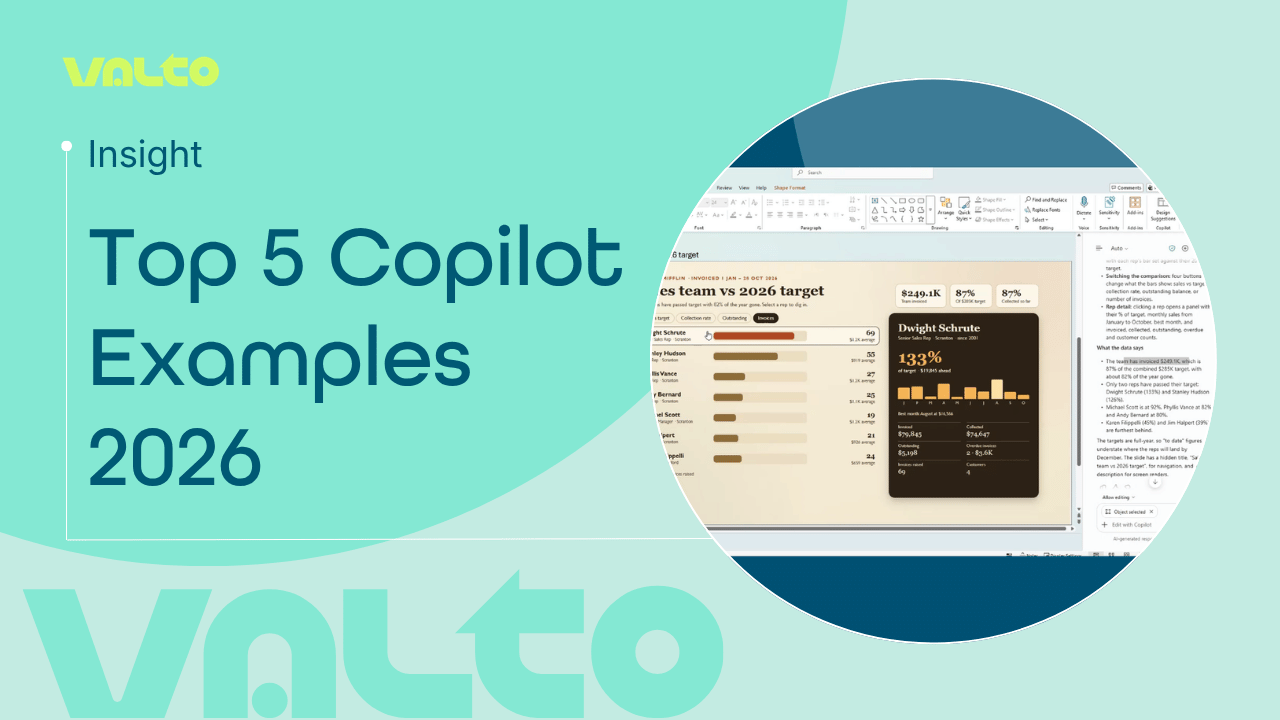
Visit our resource hub
Tell us where you are with Azure Migration
Speak directly with the consultants who design and deliver Azure Migration every day. We’ll follow up with a proposal setting out cost, approach and timeline.
Call +44 (0)333 577 9009