Valto — Keep ahead of tomorrow

News

Mastering Document Control with SharePoint

Struggling with document versioning, policy visibility or outdated files? Learn how Valto’s SharePoint-based Controlled Documents Solution solves the most common document control challenges.

SharePoint
Published
7 May 2025

Mastering Document Control with SharePoint

The Valto Controlled Documents solution has been a best seller for many years due to it being simple to use and effective in resolving common issues across organisations when it comes to managing documents.

Throughout my years of consulting, I have found myself mentioning problems to organisations and watching everyone in the room nod in agreement as they have been suffering a similar fate.

Therefore, I thought this was something worth sharing in the form of a blog post, highlighting the typical statement I heard, the definition of what the actual problem is and how Valto can solve this through deployment of our Controlled Documents Solution.

two people in a meeting with a laptop

“I don’t know what policy document will answer my questions”

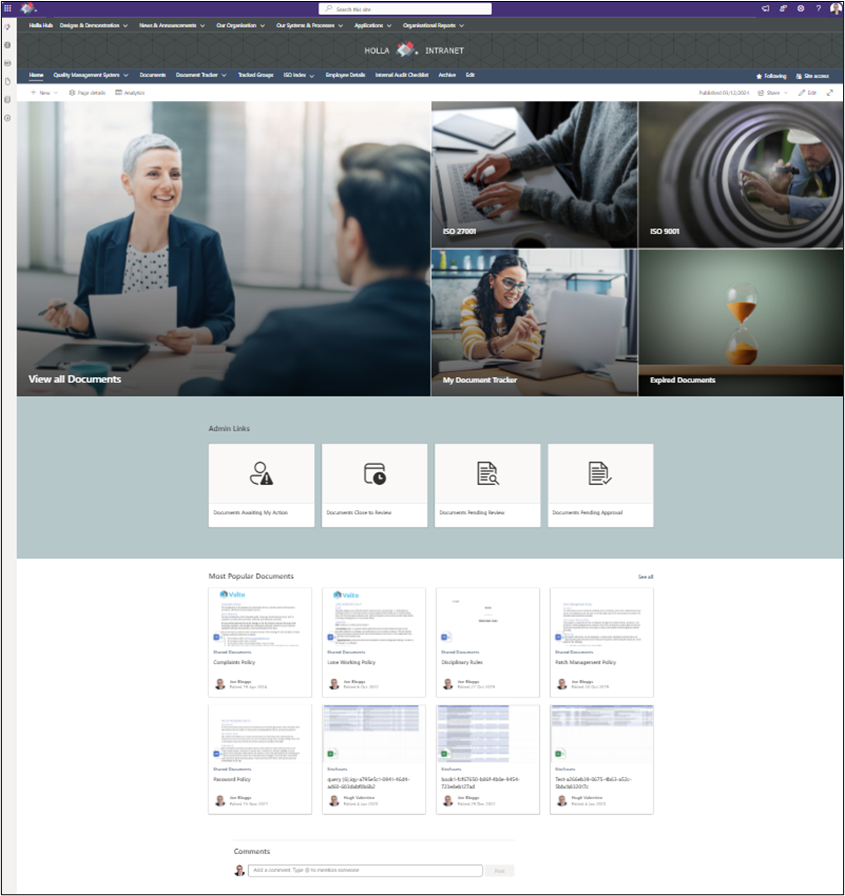
Problem: A simple problem caused by lack of information about documents being provided to the end users. This is due to documents being stored in various locations, and usually in a folder, within a folder, which sits within another folder and so on. . . At the time when this structure is created it likely makes sense, however as these folder structures evolve over time with new owners then the understanding of where I find a document and what specific document I need to use is lost. Solution: There are a few components of the Valto Controlled Documents Solution that will resolve these issues. The first is through simply deciding upon the user of SharePoint in the first instance, generating a singular site collection that is on brand and acts as a central portal to locate all the critical organisational documents: As all SharePoint Sites come with a landing page, various links and calls-to-action can be configured appropriately to aid end users. This is typically achieved by firstly listening to their needs e.g. if there is a specific document that is used regularly but can never be found, then place this front and centre with a nice big button and image as a simple signpost for your user base to consume. The next component to resolve these issues is Metadata, also referred to as tagging. Applying tags to documents allow for the to be sorted and filtered so that your users can locate what they need. These can also be used with appropriate search tools and configuration in SharePoint. As an example, documents within a global organisation may be tagged based on the department that created them, the subject matter that they cover and the language they are written in. Therefore, if I am searching for information about holiday requests that I is likely to be found when filtering by “Human Resources”, “Leave” and “English” perhaps taking me from 500 documents down to 5 – much easier to now review! From the image above, you can see the metadata in each column next to each document. Another advantage is that these columns also have conditional formatting, allowing tags to be colour coded e.g. HR is always Blue, and documents overdue for review have their date marked in red. These tags can also support the creation of views, providing a unique link to a set of pre-filtered documents that once again aids with signposting users to what they need. As an example, users may navigate from a HR Intranet page through to a central policy library, enforcing that this takes users to a view pre-filtered by “Human Resources” helps handhold the users to simplify their modern workplace experience.

“I cannot find the latest version of a document”.

Problem: Users typically do not trust a system when they cannot find a document, therefore when they request the latest version, and have it sent to them they continue to rely upon the email attachment, or a version saved on their own device for years to come.

Not only can this impact the users experience, as they may be working to outdated information, but it can also impact the organisation e.g. sending out incorrect pricing to a new client.

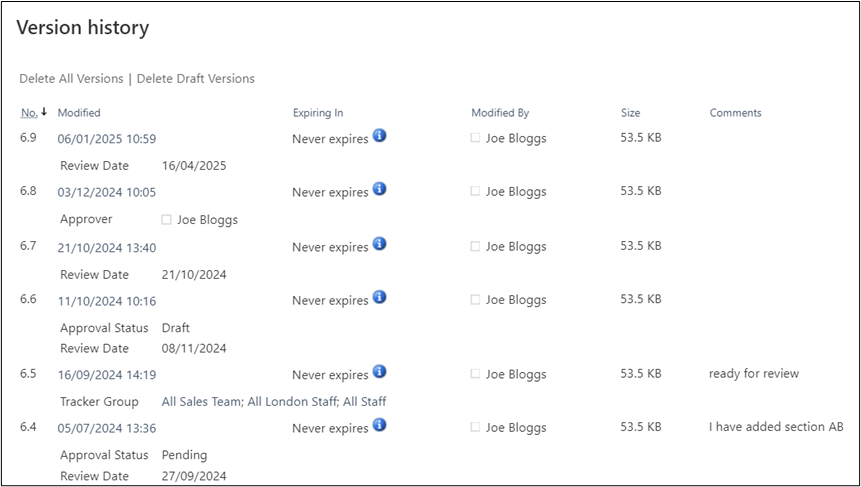
Solution: SharePoint Document Libraries have built in version control, ensuring that every minor and major version is tracked at all times, allowing for versions to be viewed, compared and restored.

These are great tools for your document administrator, but also increases the trust of your employees, as our system enforces that they are only ever opening the latest version.

Further configuration to ensure that only dedicated users can see draft versions (minor versions, like 1.3 and 2.5) also aids in solving this issue.

This ensures that users will still only see the latest published and approved versions (major versions, like 1.0 and 2.0) even if the document is really being updated by the administrators e.g. a document that is being worked on at version 2.3 will still provide version 2.0 to those who are searching for it, until version 3.0 is released following an approval process.

It is important to also note that these permissions are also considered when linking to documents from other locations.

As an example, if I was to send a link to somebody via email (as opposed to an attachment) and they saved that email to access that document years from now, the link would still navigate them to the latest version they are allowed to see.

Therefore, I may have sent them version 2.0 but now they click the link and see version 5.0 thus removing the issue of sharing or working from outdated content.

sharepoint controlled documents system

“Our template documents keep getting modified”.

Problem: Template documents are uploaded to a location; however, users forget to copy these to their own SharePoint Sites and/or Microsoft Teams Environments.

The next user accessing the template, lets imagine it is a form, is met with all the content that the user before them has added in and saved.

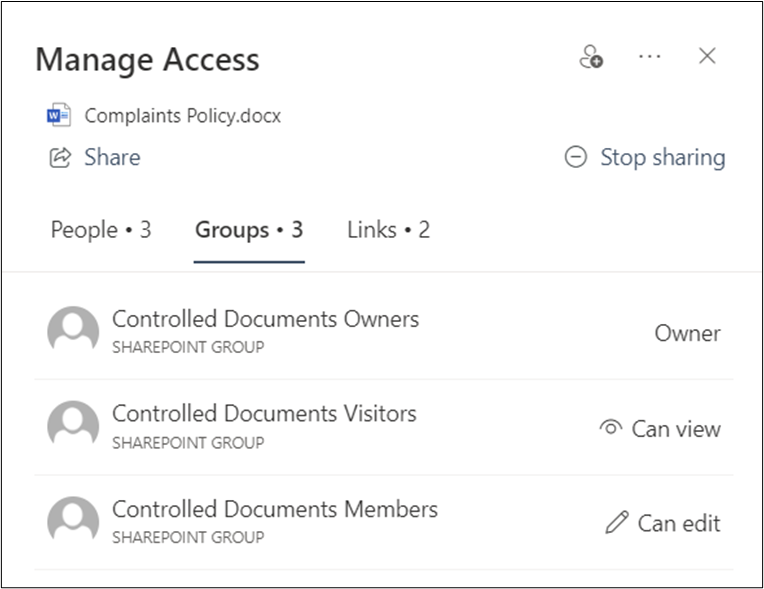
Solution: Whilst deploying our solution we always consider and configure the SharePoint permissions to ensure that only applicable users have edit and approval right, with majority of the organisation only having read access (or view if you wish to restrict download).

Typically, the “everyone except external users” groups are used to ensure the full organisation can access the documents, but that they can only read the latest version and not make unauthorised changes to it.

However, in the case of templates users can still access the document and copy or save-as to place their own version in another location and then make changes so as not to impact the original.

This is common when template documents and forms are managed centrally and kept up to date e.g. a user may need to copy a change request template into multiple projects and complete it, but the original still remain incomplete and available for others to use.

version history in sharepoint

“Our documents are always outdated”.

Problem: Documents are uploaded to a system and then never reviewed or updated again until a problem occurs, or an audit takes place.

It is common for organisations to continuously evolve their ways of working but forget to document the changes.

This is typically seen when teams begin to take on new employees, with those that have worked in the organisation for many years doing the job a certain way because “that’s how it has always been done” and new employees following the written materials because “that what the induction process told them to do”.

Solution: When ensuring quality within an organisation it is paramount to enforce that documents are reviewed at regular intervals, perhaps 6 months, 12 months or 24 months depending on the content.

These review cycles should typically align with ways of working, changes in regulation or legislation and in alignment with surveillance audits, if ISO accredited.

The Valto Controlled Documents Solution uses metadata (which was discussed earlier in the blog post) to support a set of automated review and approval processes.

With out process, users who are defined as “Reviewer”(s) will receive notifications so they will never lose track of when a document is due for review.

If the document is updated then it will be sent to the defined “Approver”(s), which can be multiple users in either serial or parrallel as required e.g. send to one person at a time or all at once.

If the document is approved the “Approval Date” will update, this will allow the “Review Date” to also be updated based on the addition of time allocated within the “Review Period” e.g. what date is it 12 months from now?

Continuing to run with this system will ensure that the documents are frequently reviewed, updated and approved to ensure that nothing is outdated.

Then when the time comes a document can be removed from the system or marked as obsolete if it no longer is applicable.

tracked groups in sharepoint

“I didn’t know that was our policy, I have never read it”.

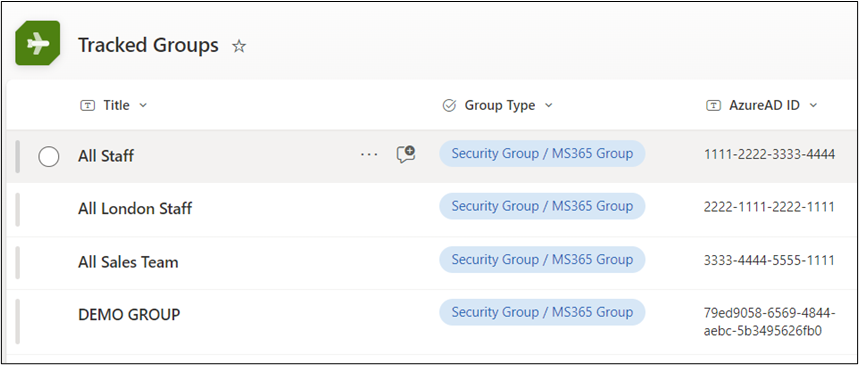
Problem: In relation to users not being able to find documents, some users may not have read specific policies or read an updated later version. This could become an issue if the user were to do something against a policy or operating procedure but state that they did not know they were doing anything wrong. Solution: The Valto solution does not only manage the documents, but it also manages the tracking and read receipts in relation to these. This ensures that an organisation collates the right amount of evidence about what has and has not been read and can also act upon users not reading specific documents. Once again this is another key piece of ISO accreditation to manage quality, as it is great that documents are reviewed and updated, but it is also just as critical that they are communicated effectively. The Controlled Documents Solution allows for metadata to be configured that defines whether a document requires a read receipt or not when updated, for example a template document may not need this, but a policy would. Further metadata then defines the applicable security groups that need to receive the read receipts, his integrates with Entra and allows for organisations to send these tasks to all employees in the organisation, or perhaps to only certain functional areas depending on the document and who it impacts. As part of the aforementioned approvals process, if approved then checks will be made to see if the document requires read receipts. If yes, the relevant security groups will be interrogated, and a task will be generated for each of the user accounts within it, sending these users and email notification also to provide them access to read the document and also mark it as read. Administrators will be able to track whether a user has stated that they have read a document or not, therefore enabling them to provide evidence if a user was to say that they have never seen the document as perhaps they have but chose not to read it, or they have read it and are saying otherwise. How this data is used within an organisation is up to the business themselves, but we see this as better to have on record than not.

Next Steps

In conclusion, all organisations we work with when deploying our Controlled Documents Solution whilst digitally transforming the business have suffered the same issues as one another, and these are likely issues that you as the reader of this blog have also experienced.

However, don’t be disheartened as there is a solution available. We would recommend a conversation with the Valto Team to clear up any questions you may have and see some additional live demonstrations.

It is also common for organisations to have slightly different bespoke needs over and above our existing deployable solution, so raise those with us also as we will definitely be able to help align the system with your ways of working.

If you need assistance with your modern workplace and document management systems, have any questions, please contact us. We’re here to help you through your digital transformation journey.

Trusted by Leading Brands

“We work with organisations across many sectors of different shapes and sizes from 10 to 100,000 employees.”

Contact Form

Contact our team today!

Talk to our team

Contact Us

Share this

Related reading

Atlassian Server is end of life
NewsSharePoint

Atlassian Server is End of Life

Is your organisation still using Confluence on an unsupported version? Discover the benefits of migrating to SharePoint Online, including better security, cost savings, and seamless integration with Office 365.

22 January 2025