


Podcast
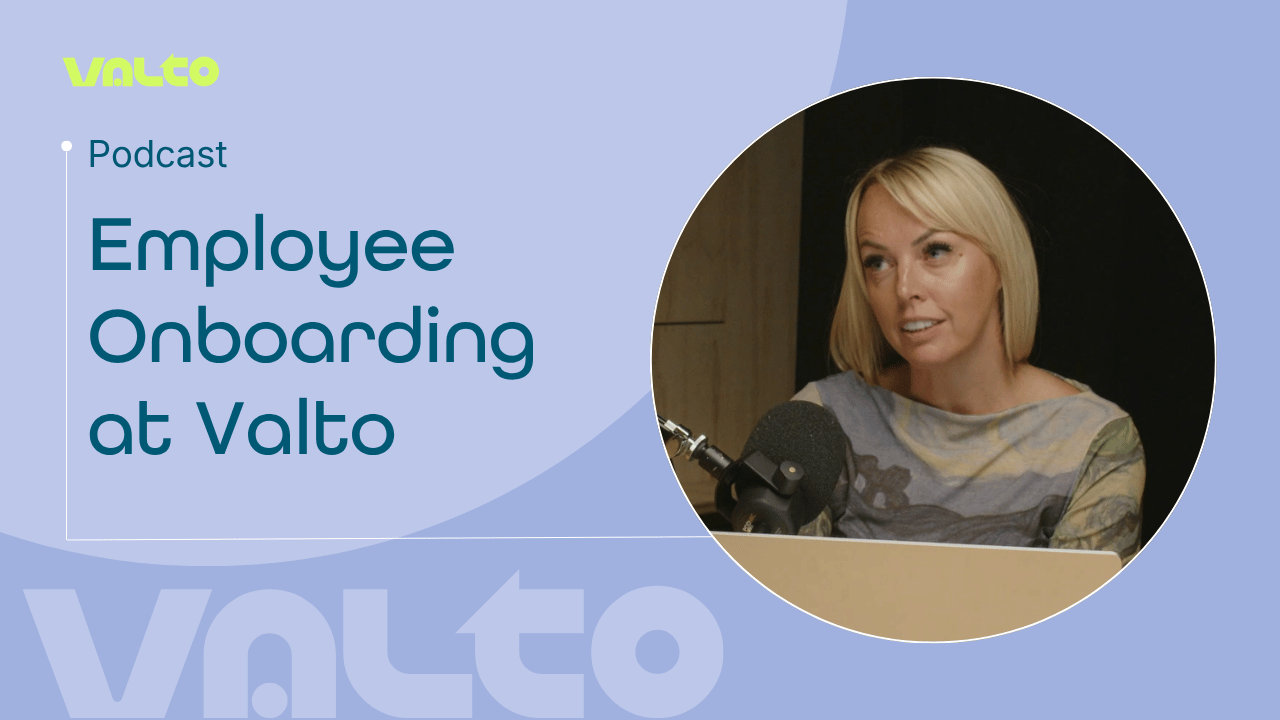
Building Better Employee Onboarding with Microsoft 365
- Episode
- #12
- Duration
- 10 min
- Guests
- Hugh Valentine, Claire Bedington
Overview
Building Better Employee Onboarding with Microsoft 365
Find out how structured onboarding, clear objectives and Microsoft 365 can help organisations support new employees beyond their first few days.
Valto experts featured in this episode


Hear from our experts
Listen to the full episode
Successful onboarding goes beyond providing a laptop, granting access and completing mandatory training. New employees need clear objectives, regular support and an understanding of what success looks like throughout their first few months. In this episode, Hugh Valentine and Claire Bedington discuss how Valto approaches employee onboarding and why the process shouldn't end after the first week. They explore the importance of managers, regular check-ins and structured 90-day and six-month plans, as well as how Microsoft 365 tools including SharePoint and Microsoft Loop are used to make information accessible and support a consistent onboarding process.
In this episode
Onboarding can become too focused on the first few days, covering immediate requirements such as equipment, access, policies and mandatory training without providing enough longer-term structure. Claire explains why support, objectives and regular check-ins need to continue beyond an employee's initial introduction to the business.
Managers help define what success looks like for a new employee. Clear objectives, measurable expectations and regular check-ins can give employees greater clarity about their role while identifying where additional coaching or support may be required.
Hugh explains how Valto uses SharePoint as an accessible source of onboarding information, giving employees somewhere to revisit policies, processes and company information rather than expecting them to absorb everything on their first day.
Valto uses Microsoft Loop to help structure onboarding plans and one-to-one processes. Hugh discusses using 90-day and six-month plans to define what employees need to learn, the support they'll receive and the objectives they'll work towards.
Claire explains why onboarding shouldn't take a one-size-fits-all approach. A junior engineer and senior engineer, for example, may require different tasks, information and support, helping employees focus on what's relevant to their role and stage of development.
Subscribe for new episodes
Be the first to hear about our latest podcast episodes, videos, news and more.
You may also be interested in
Ready to improve your employee onboarding experience?
Effective onboarding isn't confined to an employee's first day or week. By combining clear objectives, regular manager support, accessible information and structured plans, organisations can give new employees greater clarity as they develop in their roles.
Podcast transcript
Hugh Valentine:
Hello, welcome to the Valto Podcast. I’m Hugh Valentine, Founder and CEO of Valto. Today, we have a special guest with us, Claire, Head of People, talking about why so many onboarding programmes fail.
Claire Bedington:
Hi, Hugh. I just wanted to share some insight into our experience at Valto over the years that we’ve been operating.
I think many businesses do onboarding particularly well when it comes to ensuring people have the right access, laptops are delivered on time, they’ve got a really healthy setup at home for a working-from-home environment, policies are reviewed and mandatory training is completed.
I think the real problem lies in the longer-term embedding process of employee onboarding. Onboarding isn’t just one week or the first few days. It’s making sure people are set up for success in the future.
That means making sure they’ve got clear objectives, clear measures in place, strong support from their managers each day and regular check-ins so they know they’re on track.
For an organisation to evolve and grow consistently, technology needs to play a part in that to make sure those actions, tasks and support are in place.
So, Hugh, from a technology perspective, where do you see the Microsoft 365 stack supporting that?
Hugh Valentine:
There are loads of great products available in Microsoft 365 that can help.
We use SharePoint, which is our intranet platform. Historically, organisations might have a big, boring Word document that they use for onboarding, or you’re sat in a room all day.
With SharePoint, we’ve built out an intranet that is basically our living, breathing onboarding document. As we’re sitting down with people and explaining the onboarding process, our policies, how they can claim expenses and all that kind of stuff, they can load up the intranet at the same time and all of that information is available to them.
We’ve documented the full process from start to finish. We can go through it in detailed training, but at the same time they can load up the intranet afterwards.
You get so much information on your first day that you’re going to get overloaded and forget half the stuff that’s been said. If people can refer back to it later on, it makes things much easier and saves those embarrassing questions you don’t really want to ask in your first few days.
So, you mentioned managers several times. Why are they so critical to onboarding success?
Claire Bedington:
Managers define what success looks like.
If somebody joins a business, particularly if they’re inexperienced, they’ll come in and understand what Valto is about, our ways of working and our policies, but they won’t necessarily have a really clear understanding of what’s expected of them.
It’s really important that within those first few weeks, we set very clear objectives, there are clear success measures in place and managers have regular check-ins so people understand whether they’re succeeding.
There’s nothing worse than starting a job and not being sure whether you’re doing the right thing. It causes unnecessary anxiety.
If we get this right early on in somebody’s career, it can drive stronger retention because people feel happier and more settled in their role. It also enables really good progression conversations, so people can see how they can succeed through Valto.
You touched earlier on how onboarding tasks can be supported. How, within the Microsoft stack, do you see this area being supported across businesses?
Hugh Valentine:
Just to build on your point, when you onboard someone into an organisation as their manager, you’re making a commitment to their growth and their journey.
You see it far too often where people aren’t dedicating the coaching time and there are vague KPIs. That can then result in people leaving.
We’ve developed some processes. Some of them aren’t super smart because they evolve, and we’re a growing business.
We use Microsoft Loop really heavily. We’ve defined our onboarding process within there. As part of the onboarding journey, everyone in Valto should define a full 90-day and six-month plan for that employee, including exactly what they’re going to learn, what they’re going to cover and how much time you’ve dedicated to supporting them.
From there, we look at the one-to-one process as a way of checking in. Again, we use Loop, and it’s built across all the managers in the organisation.
It’s a way of making sure that we’re following the same process for everybody. We talk through KPIs and objectives, whether people are performing at the right level, what they need from a coaching perspective and their wellbeing.
It’s a really simple solution, but Loop is really good for us because it means we can quickly evolve and adapt it as we grow and change.
Claire Bedington:
I agree.
Hugh Valentine:
So, Claire, what are the tangible benefits of getting onboarding right?
Claire Bedington:
I think we touched on it earlier.
For me, when somebody joins a business, particularly if they’re new from university or inexperienced within the role, it’s really important that they’ve got very clear objectives early on in their career.
If they don’t have that, it can create workplace anxiety because they’re not sure if they’re meeting expectations. There can be a fear of not doing well.
Having that clarity upfront, knowing what’s expected of you week on week, and having check-ins to make sure that you’re hitting your KPIs gives people the opportunity to get coaching where they’re struggling or need additional support.
That really helps people gain clarity as they move forward.
Longer term, the biggest benefit for me would be staff retention. If people feel well supported and feel they’ve got an opportunity to progress at Valto, with a clear understanding of how they achieve that progression, I think people will stay with us.
It creates a great workplace experience and great opportunities for people.
What value do you see as a CEO here?
Hugh Valentine:
We work in an industry where there aren’t a lot of people available. Getting people on defined career paths can be quite expensive, and there’s a lot of demand for senior developers.
What we’ve found really helps us is bringing in junior talent and then growing them and shaping them into what we need from a development perspective.
It’s been a huge benefit because we’re bringing in graduates in their first roles in organisations. That onboarding journey is critical because we want them to be successful quickly.
If they’re hanging around for 12 months and haven’t progressed, then that’s not really what we’re looking to achieve. With our plan, we’re trying to get them useful and working on good projects within three to six months.
That’s all around how effective our onboarding is in making that happen.
So, if you could change one thing about onboarding, what would it be, Claire?
Claire Bedington:
It would probably be two things.
First, I’d make sure that onboarding didn’t just focus on the first couple of weeks. I know at Valto we do that particularly well, but it’s about ensuring that the onboarding journey continues throughout the whole probation period, with that support, structure and plan.
In addition to that, onboarding shouldn’t just be generic at a department level. It should be role-specific.
If you’re coming in as a senior engineer versus a junior engineer, you should have very specific, role-based tasks to complete.
That helps prevent people from feeling overwhelmed by information they’re not ready to use at that point in their career journey.
So, Hugh, back in the day, maybe five years or so ago, why did Valto decide to build the onboarding system? What value did you want it to bring, and do you feel that you’ve achieved that?
Hugh Valentine:
Onboarding at most organisations can be really bad.
I remember working for a company where I sat down for a full day with the most boring man on the planet and nearly fell asleep. It just wasn’t a great onboarding experience. I didn’t learn anything, and I was basically trying to learn a full three months of knowledge in one day, which isn’t going to happen. You’re just going to forget 90% of what you’re talking about.
Over time, we’ve evolved our process. There are things we need people to learn when they join the organisation, but you can’t learn it all in one day.
We try to create a 90-day plan, perhaps leading into a six-month onboarding plan, and break down everything that people need to learn at a company level.
That includes reading all the required policies, going through those policy documents and making sure they understand them. Again, you’re not going to read 15 policy documents in one day, so why ask someone to do that? Instead, we break those policies up over a period of time.
We also have information people need to know, such as our travel and expenses policies and how they can claim those things.
Finally, we’ve got departmental knowledge that each person needs to understand. Every department will have its own ways of working and its own tools.
Effectively, we can set up company and departmental knowledge, break that plan down over the 90 days and make sure people are taking in everything they need.
It means that during the first day, we’re signposting people to the key things they need: welcome to Valto, introductions to the key people they need to know, policies, documents and their onboarding plan.
They can then take all of that information in over a more manageable period of time.
Within the onboarding system, we can also build milestones. We like people to pass some of their fundamentals exams, so we can build those in as tasks they should complete after one or two months and use them as a knowledge check to make sure they’re progressing and don’t need additional support in those areas.
Claire Bedington:
That makes sense, and it ties nicely into the objectives.
If we’re setting goals such as completing certain exams, ensuring that people complete those exams forms part of the goals and KPI setting. It’s about setting people up for success and making sure they know what they need to complete within a defined period.
Hugh Valentine:
Perfect. Thank you, Claire.
Thank you very much for listening to our podcast today.
If you want more information about working with Valto, visit our website at valto.co.uk.
If you’d like a demo or more information about our onboarding system, just get in touch.
Thank you, Claire.
Claire Bedington:
Thanks, Hugh.
More like this